For this new episode of Designers in Dialogue, we had the pleasure and privilege of interviewing Hugo Besnier, designer and founder of Hartis Paris. During our conversation, he discusses an aesthetic forged between the excitement of Paris and the tranquility of Fontainebleau, inspired by his grandmother, who passed on her passion for design and craftsmanship to him. After business school and a career in equestrianism, he founded Hartis and launched his first collection, “Tour de Mains”, developed in close collaboration with exceptional artisans.
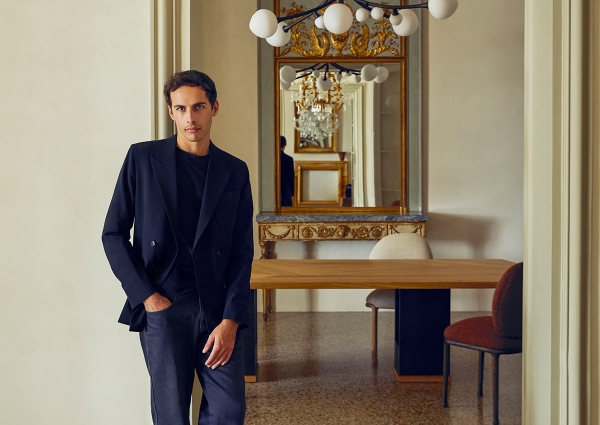
Hello Hugo, and thank you for agreeing to this interview. To begin, could you tell us about your background?
”I grew up between Paris and Fontainebleau, surrounded by Haussmannian architecture, horses, and centuries-old oak trees. I spent a great deal of time with my grandmother, who possessed a true sense of decoration and created compositions like a genuine ensemblière: she carefully selected and sourced each object, ensuring that everything was useful, comfortable, and carried a story. From doors she delighted in hiding as secret passages in old castles to seasonal flowers she repurposed as curtain tiebacks, nothing was left to chance. She gave me my first memories of interior spaces. And then there was The Sims, which I discovered around the age of eleven! I would spend hours building and furnishing houses, often cheating to have unlimited budgets…
Simultaneously, until I was eighteen, I competed internationally in horseback riding. This discipline instilled in me a profound respect for living beings and for the collaborators around me. Through immersion in exceptional craftsmanship—saddlery, shoemaking, farriery—my grandmother introduced me to the nobility of materials, particularly leather, the importance of meticulous attention to detail, and the value of perseverance.
In 2018, I chose to pause this path in order to prepare for business school entrance exams. After two intense and formative years, I enrolled at the Lyon School of Management in 2020. I rented my first apartment at 26 Place Bellecour, above the Bullukian Foundation. Not wishing for a typical “student” apartment, and rather than purchasing standard furniture, I began designing, crafting, and sourcing each element of my interior. Two months after moving in, my prep school mentor visited Lyon and discovered my early creations. Having just acquired a private mansion in Neuilly-sur-Seine, he offered me the opportunity to assist with its decoration. I accepted immediately…
This extraordinary opportunity led me to establish Hartis, design my first furniture collection, and collaborate with several distinguished French workrooms. The brand quickly developed, expanding first to the United States, then Europe and India. In October 2025, we opened our first exhibition apartment, showcasing approximately thirty pieces from the Tour de Mains collection.”
Could you introduce your “Carrelet” furniture collection?
”For the Tour de Mains collection, I wished to create an armchair and sofa ensemble that would be exceptionally comfortable, warm, and inviting. When I began designing them, I recalled my childhood nanny, Roberte—a formidable yet gentle woman, with generous, reassuring, and enveloping forms, whom one always wanted to embrace. She reminds me of Niki de Saint Phalle’s Nanas.
Every piece I design carries a touch of wood. In these two fully upholstered pieces, I sought to preserve that memory by incorporating a crosspiece beneath the rounded seat. My design process is iterative: I adjust, refine, and revisit. I felt that the back still needed something. I drew inspiration from a chair by the talented Charlotte Kingsnorth, with its four large asymmetric legs, and Jean Royère’s Polar Bear. I ultimately endowed the pieces with four asymmetric legs, reminiscent of a pair of plump, rounded forms.”
Does the name of your collection hold particular significance or symbolism?
”Tour de Mains is, above all, a tribute to the hand that creates. The collection celebrates gesture, transmission, and the precision of craftsmanship that transcends borders and eras. It is the hand that transforms an idea into an object, a drawing into presence. It evokes the emotion that arises when material begins to take shape under an artisan’s fingers.
This tribute resonates particularly in France, where each region preserves exceptional heritage, passed down by artisans, master craftsmen, and family-run workrooms, where time is measured by the rhythm of labour. Hartis situates itself fully within this tradition: every piece is executed by the finest workrooms, preserving rare techniques with extraordinary exactitude. Such excellence is the product of generations of passionate men and women who have chosen to create beauty with their hands.
Within this framework, each piece of Tour de Mains bears the name of a technique or tool of the craft, making visible what is usually hidden. The Carrelet armchair and sofa exemplify this perfectly: the carrelet, a curved needle, allows for invisible stitching, hand-sewing the fabric of the backs while perfectly following the contours of the slits.”
What are your daily sources of inspiration for your creations? (environment, travel, personal experiences…)
”I am inspired by the fertile tension between architecture and the living world: the rigor of lines, proportions, and structure meeting the curves, happy accidents, and unpredictable textures of nature. Architecture represents order, the backbone, the promise of solidity; the living world is its complementary opposite—poetry, emotion, and the sensitive element that softens and humanizes the object.
This dialogue has accompanied me since childhood and is nourished by my travels: the spirituality of forms in Japan, the exuberant organic landscapes of Thailand and Vietnam, the unapologetic modernity of Seoul, the monumental landscapes of the United States, and the mineral light of Athens. Everywhere, I observe how a place breathes, how people inhabit space, and how materials age.
These experiences fuel my appreciation for “authentic” materials—wood, stone, leather, glass—that tell the story of time and bear the mark of the hand. Ultimately, everything begins with essential gestures: sitting at a table, leaning, resting. Design must serve life, welcoming the body comfortably and warmly, without ever imposing fear of damage. I reject both gratuitous decoration and brutal functionality: my pieces must be delicate yet robust, precise yet vibrant. It is in this balance—between strength and softness, structure and organicity, mastery and freedom—that a design emerges, one meant not merely to be seen, but fully experienced.”
What relationship do you maintain today with artisans?
”They give my designs weight, substance, and life. It is a constant dialogue between their expertise and my intention. We progress together at each stage, questioning the material based on their intimate knowledge. This intelligence of gesture nourishes my work. I admire these crafts, passed down through generations, shaping living heritage. I am grateful to contribute, in my own way, to their global recognition.
In France, we are extraordinarily fortunate to have artisans who perpetuate exceptional savoir-faire. Each Hartis object results from a conversation with them. They are also sources of innovation, capable of developing new techniques to explore finishes that only they can truly master.”
How did your collaboration with our workrooms unfold throughout the design and production process?
”Everything was seamless. A year ago, I submitted my first sketches for costing. We quickly progressed to more detailed studies. After refining the work with the design team and receiving the first 3D models, we arranged an in-person meeting in one of the Lyon atelier’s meeting rooms to discuss and adjust the Carrelet models in real time on a large screen. Such efficiency! I then approved the plans, and production commenced. A few weeks later, I returned to observe progress and test the seating. After minor adjustments, I received the first armchair and sofa—comfort without equal.
I must emphasize how sensitive I am to energy and human interaction in first encounters. I am impressed by how Charles and Romain infuse a familial spirit and remarkable energy throughout the workrooms. Every interaction with the teams is a genuine pleasure—I know, even before picking up the phone to discuss a new project, that it will be warm, cordial, and productive.”
You chose to hold the opening of your exhibition in a legendary Parisian apartment on Quai Anatole. How does this location embody the spirit of your collection?
”Since childhood, I had passed by the large glass roof of this apartment while walking along the Seine with my grandmother. It always captivated me. I never failed to let my gaze linger upon it. When I founded Hartis in early 2020, I continued to pass by, looking at it with the same awe, thinking, “One day, I will install my pieces here.”
Last year, searching for a Parisian space to present the collection, I contacted Barnes. I desired an exceptional location with history, soul, architecture, and a view unlike any other. In June, their team presented photos of an apartment… and I immediately recognized the glass roof! I could hardly believe it. Nothing was confirmed yet, but I knew instantly it was the one. The emotion of that first visit remains with me. It was evident—I could not have dreamed of a better setting: terrazzo overlooking the Seine reminiscent of Venice, views spanning from Concorde to the Louvre, the ballet of the tourist boats, the 19th-century building steeped in history… everything resonated.
This place embodies Paris and the “elsewhere”, history and dream. It represents the timelessness I seek in my creations. It is a setting that allows me to present the Tour de Mains collection not as a succession of impersonal objects, but as a lifestyle, a way of inhabiting space. It is a pause, a breath in the movement of the world, where furniture becomes a resident of the space. The pieces naturally find their place; one can touch them, sit on them, and imagine them in daily life.”
Finally, could you share a guiding principle or personal motto that informs your daily creative approach?
”The hand that shapes, the nobility of materials, and conviviality are fundamental. I aim to design objects imbued with warmth, that protect and bring people together. Objects that carry the soul of their makers and the life of those who use them. Furniture that welcomes essential gestures—sitting, leaning, resting. Living pieces, comfortable, to be used without hesitation or fear of damage. Hartis offers a lifestyle that warms and unites.”
© Photos Jean-François Jaussaud & Matthieu Salvaing